

Description: In this blog post, we present to you an exclusive and comprehensive guide to the top 10 must-have gadgets of the year. Whether “SSD” and “Electronic disk” redirect here. For other uses, see SSD (disambiguation) and Electronic disk (disambiguation).
| A 2.5-inch Serial ATA solid-state drive (Patriot P210 2TB) | |
| Usage of flash memory | |
|---|---|
| Introduced by: | SanDisk |
| Introduction date: | 1991; 35 years ago |
| Capacity: | 20 MB (2.5-in form factor) |
| Original concept | |
| By: | Storage Technology Corporation |
| Conceived: | 1978; 48 years ago |
| Capacity: | 45 MB |
| As of 2025 | |
| Capacity: | Up to 245 TB |


| Computer memory and data storage types |
|---|
| General |
| Volatile |
| RAM |
| Historical |
| Non-volatile |
| ROM |
| NVRAM |
| Early-stage NVRAM |
| Analog recording |
| Optical |
| In development |
| Historical |
| vte |
A solid-state drive (SSD) is a type of solid-state storage device that uses integrated circuits to store data persistently. It is sometimes called semiconductor storage device, solid-state device, or solid-state disk.[1][2] Etymologically, “solid-state drive” partly refers to existing data storage devices like tape drives and hard disk drives, which all used a mechanically driven storage medium.
SSDs rely on non-volatile memory, typically NAND flash, to store data in memory cells. The performance and endurance of SSDs vary depending on the number of bits stored per cell, ranging from high-performing single-level cells (SLC) to more affordable but slower quad-level cells (QLC). In addition to flash-based SSDs, other technologies such as 3D XPoint offer faster speeds and higher endurance through different data storage mechanisms.
Unlike traditional hard disk drives (HDDs), SSDs have no moving parts, allowing them to deliver faster data access speeds, reduced latency, increased resistance to physical shock, lower power consumption, and silent operation.
Often interfaced to a system in the same way as HDDs, SSDs are used in a variety of devices, including personal computers, enterprise servers, and mobile devices. However, SSDs are generally more expensive on a per-gigabyte basis and have a finite number of write cycles, which can lead to data loss over time. Despite these limitations, SSDs are increasingly replacing HDDs, especially in performance-critical applications and as primary storage in many consumer devices.
SSDs come in various form factors and interface types, including SATA, PCIe, and NVMe, each offering different levels of performance. Hybrid storage solutions, such as solid-state hybrid drives (SSHDs), combine SSD and HDD technologies to offer improved performance at a lower cost than pure SSDs.
Attributes
An SSD stores data in semiconductor cells, with its properties varying according to the number of bits stored in each cell (between 1 and 4). Single-level cells (SLC) store one bit of data per cell and provide higher performance and endurance. In contrast, multi-level cells (MLC), triple-level cells (TLC), and quad-level cells (QLC) store more data per cell but have lower performance and endurance. SSDs using 3D XPoint technology, such as Intel’s Optane, store data by changing electrical resistance instead of storing electrical charges in cells, which can provide faster speeds and longer data persistence compared to conventional flash memory.[3] SSDs based on NAND flash slowly leak charge when not powered, while heavily used consumer drives may start losing data typically after one to two years unpowered in storage.[4] SSDs have a limited lifetime number of writes, and also slow down as they reach their full storage capacity.[citation needed]
SSDs also have internal parallelism that allows them to manage multiple operations simultaneously, which enhances their performance.[5]
Unlike HDDs and similar electromechanical magnetic storage, SSDs do not have moving mechanical parts, which provides advantages such as resistance to physical shock, quieter operation, and faster access times. Their lower latency results in higher input/output rates (IOPS) than HDDs.[6]
Some SSDs are combined with traditional hard drives in hybrid configurations, such as Intel’s Hystor and Apple’s Fusion Drive. These drives use both flash memory and spinning magnetic disks in order to improve the performance of frequently accessed data.[7][8]
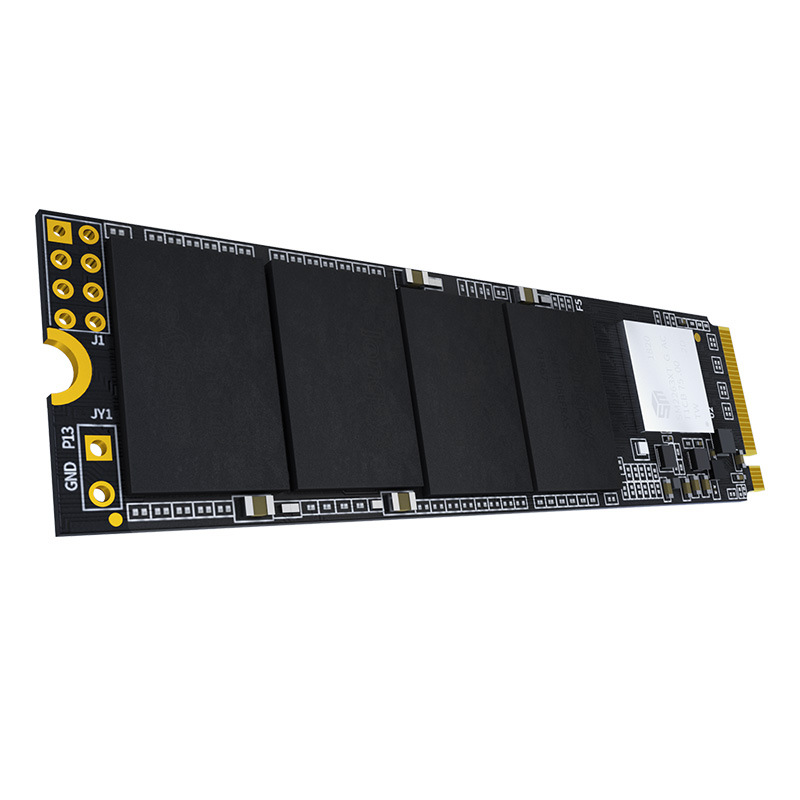
Traditional interfaces (e.g. SATA and SAS) and standard HDD form factors allow such SSDs to be used as drop-in replacements for HDDs in computers and other devices. Newer form factors such as mSATA, M.2, U.2, NF1/M.3/NGFF,[9][10] XFM Express (Crossover Flash Memory, form factor XT2)[11] and EDSFF[12][13] and higher speed interfaces such as NVM Express (NVMe) over PCI Express (PCIe) can further increase performance over HDD performance.[3]
Comparison with other technologies
Hard disk drives
See also: Hard disk drive performance characteristics

Traditional HDD benchmarks tend to focus on the performance characteristics such as rotational latency and seek time. As SSDs do not need to spin or seek to locate data, they are vastly superior to HDDs in such tests. However, SSDs have challenges with mixed reads and writes, and their performance may degrade over time. Therefore, SSD testing typically looks at when the full drive is first used, as the new and empty drive may have much better write performance than it would show after only weeks of use.[14]
The reliability of both HDDs and SSDs varies greatly among models.[15] Some field failure rates indicate that SSDs are significantly more reliable than HDDs.[16][17] However, SSDs are sensitive to sudden power interruption, sometimes resulting in aborted writes or even cases of the complete loss of the drive.[18]
Most of the advantages of solid-state drives over traditional hard drives are due to their ability to access data completely electronically instead of electromechanically, resulting in superior transfer speeds and mechanical ruggedness.[19] On the other hand, hard disk drives offer significantly higher capacity for their price.[6][20]
In traditional HDDs, a rewritten file will generally occupy the same location on the disk surface as the original file, whereas in SSDs the new copy will often be written to different NAND cells for the purpose of wear leveling. The wear-leveling algorithms are complex and difficult to test exhaustively. As a result, one major cause of data loss in SSDs is firmware bugs.[21][22]